CrossGrams - PvP Puzzle Game
- 4.9
- Rating
- 10.00K
- Installs
- Free
- Price
 Analysis by App-foxy
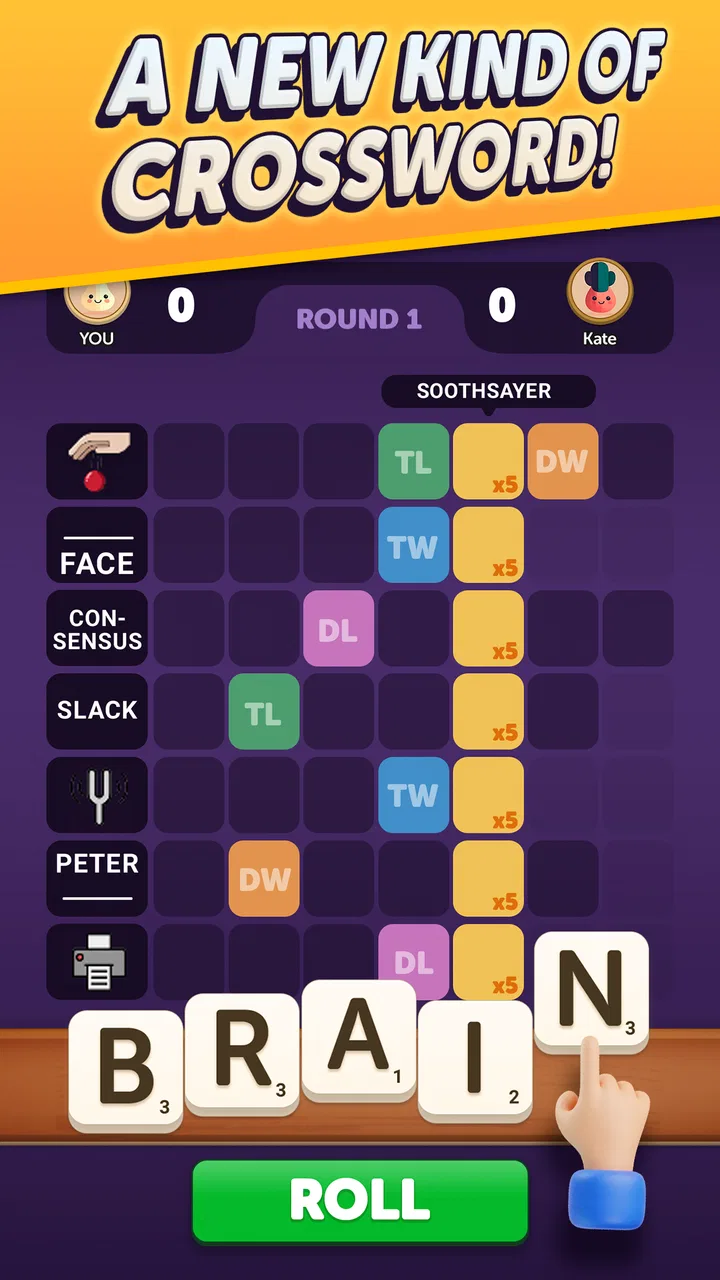
I went into CrossGrams - PvP Puzzle Game expecting a familiar word puzzle with a competitive layer, and that is exactly the kind of experience it presents: a trivia-focused game built around crossword duels. The basic appeal is easy to understand. Instead of solving a crossword entirely on my own, I am encouraged to think quickly, make useful word connections, and treat each puzzle as a contest rather than a quiet solo exercise.
That difference matters more than it may seem. Traditional crossword apps are usually about patience, vocabulary, and personal progress. CrossGrams places more weight on the moment-to-moment decision of what I can solve now and how that answer helps me keep control of the board. It feels better suited to short sessions than to a long, relaxed newspaper-style solve, although players who dislike pressure may find the competitive framing less comfortable.
FunCraft Games is the developer behind this free trivia game. It is available for an Everyone audience, runs on Android 7.0 and later, and the current version is 1.1.25159. The game was released on March 4, 2026, and its early reception is encouraging, with a 4.8 average from around 300 ratings and more than 10 thousand installs. Those figures suggest a promising start, while also reminding me that the player community is still relatively small compared with established word-game brands.
You May Also Like

 AccuWeather: Weather Radar
AccuWeather Review: A Quick, Clear Forecast for Everyday Decisions
For everyday plans, the best forecast is the one you can understand quickly. AccuWeather makes rain timing, radar, and local conditions easy to act on, with a few trade-offs.

 Hill Climb Racing
Why Hill Climb Racing Still Turns Crashes Into One More Run
A tiny car, a bumpy hill and one more upgrade: Hill Climb Racing keeps resurfacing because its simple chaos makes every near-miss feel personal.

 AliExpress - Shopping App
AliExpress Makes Global Shopping Feel Personal, but Shoppers Bear the Risk
AliExpress turns a global marketplace into a pocket-sized discovery engine. Its reach is useful, its shopping loop compelling, and its trade-offs easy to miss.

 Lords Mobile: Kingdom Wars
Lords Mobile Is a Kingdom-Building Routine, Not a Quick Match
A case-by-case verdict on the building, battles, device demands, and social commitments that make Lords Mobile rewarding for some players and exhausting for others.

 PDF Scanner app - TapScanner
TapScanner Makes Paperwork Easier to Capture, Check, and Share
TapScanner makes scanning with a phone feel less like a rescue operation and more like a dependable step in getting work done. Its capture tools are useful, though not flawless.

 Block Blast!
 Shows How Much a Puzzle Game Can Leave Out
A quiet grid game shows why puzzle players increasingly value instant clarity, repeatable skill and low-pressure play—and where the genre still needs to catch up.
More From Our News Desk
View All News


How to decide whether CrossGrams fits your play style
I’d start by asking what I want a word game to do for me: provide a calm puzzle to return to at my own pace, or make clue-solving feel like an active contest. That distinction matters more than familiarity with crosswords, because it shapes whether the duel format becomes a welcome habit or an unwanted demand on my attention. The next section looks at the situations where that competitive structure pays off most.
Choose the kind of puzzle experience you actually want
The first question is whether I want a crossword for concentration or a crossword for competition. If my ideal session involves slowly filling every clue, checking an answer, and enjoying the satisfaction of a completed grid without anyone interrupting the rhythm, a conventional crossword app may be a better match. CrossGrams makes more sense when I want the familiar vocabulary challenge but also enjoy the tension of a duel.
That distinction is useful before downloading because the same puzzle format can serve very different moods. I would choose this game when I have a few spare minutes and want something active. I would choose a solo crossword alternative when I am commuting without a reliable connection, trying to relax before bed, or looking for a more reflective brain-training routine. The competitive angle is the main reason to pick CrossGrams, not a minor extra attached to an ordinary crossword.
I also considered how much trivia knowledge the game expects from me. Crossword solving is not only about spelling. Clues can depend on general knowledge, word associations, and recognizing the likely length or structure of an answer. That makes each duel a mixture of recall and deduction. A player who enjoys learning through clues may find that combination rewarding, while someone who dislikes being tested on broad knowledge may experience more frustration than entertainment.
Think about session length and attention
CrossGrams is most appealing when I can give the screen my full attention for a short stretch. In a duel, hesitation has a cost even when the clue itself looks simple. I found that the game encourages a different solving habit from a paper crossword: instead of staring at one difficult clue until it yields, I need to scan for openings and use the answers I already understand to make the rest of the puzzle easier.
That is one of the more useful ways to approach it. I would not treat every clue as an isolated question. I would first look for answers that seem immediately recognizable, then use crossing letters to narrow down uncertain words. This turns the game into a sequence of small decisions rather than a test of whether I know every answer instantly. It is a practical technique for newer players and also helps experienced crossword fans avoid wasting a turn on one stubborn clue.
A realistic everyday use case is a short break between errands. I can open the game, play a duel while waiting, and leave with the feeling that I used the time for something more engaging than scrolling. The same format can work during a lunch break or as a quick evening challenge with a friend. I would be less likely to choose it for a long uninterrupted session unless I already knew that the competitive pace suited me.
Separate the free entry point from the long-term value
The game is free to download, which makes trying it straightforward. There are in-app purchases ranging from $0.99 to $49.99 per item, so I would approach the purchase system with a clear personal limit rather than assuming that the free starting point tells me the complete cost of regular play. The sensible test is simple: play without spending first, decide whether the core duels are enjoyable, and only then consider whether any optional purchase improves the experience enough to justify it.
This is especially important for a competitive puzzle game. In a solo crossword, paying for a hint may feel like a private convenience. In a duel, anything that affects how quickly I can continue or recover from a difficult clue can feel more significant. I would pay attention to whether purchases are genuinely optional in my own routine and whether I still enjoy the game when I rely on my solving ability rather than spending.
The Everyone rating makes CrossGrams approachable for a broad audience, but an age label does not determine whether the competitive mood will suit every player. Younger users may enjoy the wordplay, while parents should still decide whether the purchase settings and competitive format fit their household rules. For adults, the more relevant question is not content maturity but tolerance for quick decisions and repeated contests.
What I would check before making it a regular game
Because the community is still growing, I would give matchmaking and opponent availability some thought. A competitive game benefits from a healthy flow of players. With more than 10 thousand installs, CrossGrams has a meaningful starting audience, and the rating is a positive sign, but it is not yet in the same visibility class as the biggest crossword or trivia games. I would treat that as a practical consideration rather than a criticism.
I would also check how well the game fits my preferred device. Android users need version 7.0 or newer, which covers many devices but not every older phone or tablet. On a small screen, clue reading and letter entry can feel more demanding than on a larger display. If I often play on an aging handset, I would test the interface before committing to long sessions, particularly if quick responses are important to the result.
Where CrossGrams is strongest
For me, the strongest case for CrossGrams is not simply that it puts crosswords into a duel; it is that the format gives each answer a practical role in how I approach the puzzle. I’d use it to sharpen clue selection and learn when to move on rather than stall. That strength has limits, though, and it helps to compare it with other kinds of word and trivia games.
It gives crossword solving a clear reason to feel urgent
The strongest idea here is the combination of crossword structure and player-versus-player tension. A normal crossword gives me one opponent: the puzzle itself. CrossGrams adds another layer by making speed, selection, and confidence part of the experience. I am not simply asking whether I know a word; I am deciding whether it is worth pursuing now or whether another clue offers a safer route forward.
That creates a useful mental shift. If I find a clue that is almost familiar but not quite, I can leave it temporarily and solve around it. The crossing letters I gain may turn an uncertain answer into an obvious one later. This approach is more strategic than randomly guessing, and it is one of the non-obvious strengths of a duel format: it rewards managing uncertainty, not just having a large vocabulary.
I also like that the game sits between two categories. It has the recognizable shape of a crossword, but the trivia element makes it feel broader than a pure word-placement exercise. Players who enjoy quiz games may appreciate the clue-solving side, while crossword fans get a more active setting than a standard daily puzzle. That overlap gives CrossGrams a distinct identity instead of making it feel like a basic crossword copied into a mobile format.
It works well for competitive learning
Playing against another person can expose weaknesses in my solving habits quickly. If I repeatedly lose time on clues that I could answer with a little structure, the problem may not be vocabulary alone. I may be reading clues too narrowly, ignoring crossing letters, or spending too long trying to force an answer. A useful personal routine is to notice which type of clue made me hesitate and adjust my approach in the next duel.
For example, I would separate mistakes into three groups: clues I genuinely did not know, clues I knew but read incorrectly, and clues where I had the answer but entered it too slowly. Each group calls for a different response. The first suggests building general knowledge; the second suggests slowing down enough to parse wording; the third suggests improving the order in which I attack the grid. That kind of self-review gives the game more value than simply replaying until I win.
This makes it suitable for friends or family members who enjoy light competition without wanting a complicated strategy game. The rules are grounded in words and clues, so the barrier to entry is lower than in a card battler or a tactical multiplayer title. At the same time, the duel format gives experienced players room to develop better habits instead of treating every round as a random quiz.
The small install base can be a positive starting point
A newer game can feel less intimidating than a long-established competitive platform. I do not need years of accumulated rankings or knowledge of a huge meta before trying a few rounds. CrossGrams has a 4.8 average rating from around 300 ratings, which indicates that the early audience has responded warmly. I would not treat that as proof that every player will enjoy it, but it is enough to make the game worth investigating if crossword duels already sound appealing.
There is also a benefit in discovering a game while its identity is still forming. Early players can decide whether they prefer quick solving, careful deduction, or friendly rivalry, and their experience may feel less dominated by experts than a mature competitive app. The trade-off is that a smaller audience can make the social side less dependable, so I would judge the game by the quality of the puzzle loop rather than by the promise of constant opponents.
Three practical techniques that improve the experience
My first tip is to treat easy answers as tools, not merely points. A clue I can solve immediately may reveal letters that unlock a harder section of the grid. I would scan for those high-confidence entries before chasing an obscure answer. This is particularly valuable in a duel because it produces information quickly and reduces the chance of getting trapped in one corner.
My second tip is to use a two-pass method. On the first pass, I would answer only clues that feel solid and avoid speculative entries. On the second, I would return to the remaining clues with the new crossing letters. This method limits careless guesses and turns the grid into a process of elimination. It also makes the game feel less like a memory contest when a clue initially seems outside my knowledge.
My third tip is to judge a loss by the decision that caused it, not only by the final result. If I lost because I spent too long on one nearly remembered answer, the lesson is about time management. If I lost because I rushed several uncertain clues, the lesson is about accuracy. That distinction helps me improve without assuming that every defeat means I need a larger vocabulary.
Where another type of game may fit better
I’d choose a different game when the mood I want conflicts with CrossGrams’ competitive pace, not because one format is universally better. A solo crossword can suit patient, uninterrupted solving, while broader trivia may be preferable when I want questions across subjects without working through a grid. The useful next step is to consider what adopting this game would change in my regular play routine.
Solo crossword apps remain better for calm, uninterrupted solving
The clearest alternative is a traditional solo crossword game. It is the better choice when I want to set my own pace, pause frequently, or use the puzzle as a quiet daily ritual. A solo app usually gives me more control over the emotional temperature of the session. I can spend several minutes on one clue, take a break, and return without feeling that another player has gained an advantage.
CrossGrams is not the right recommendation for someone who dislikes time pressure or competitive comparison. Even a well-designed duel can make a familiar hobby feel like a performance test. If the main pleasure comes from slowly appreciating word choices and completing a grid without interruption, the usual alternative will probably be more satisfying.
Broad trivia games may suit players who want wider question variety
A general trivia game is another reasonable alternative. It may cover more subjects directly, while CrossGrams filters its challenge through crossword-style clues and word relationships. I would choose a broad quiz game if I wanted rapid questions about many topics with less emphasis on spelling, crossing letters, and grid planning.
On the other hand, players who enjoy both knowledge and language may find CrossGrams more rewarding because each answer has a structural role. A correct word does not stand alone; it can help confirm nearby answers and guide the next decision. That extra layer is precisely what makes it different from answering a series of unrelated multiple-choice questions.
Relaxed word games may be preferable for casual repetition
Word searches, anagrams, and other noncompetitive word games are often easier to play while multitasking. They can be a better fit when I want a low-stakes activity that does not punish distraction. CrossGrams asks me to stay mentally present, so I would not choose it while watching a film, listening to a complicated podcast, or handling another task.
The trade-off is that those calmer alternatives may not provide the same sense of progress from reading clues, forming answers, and using the grid as evidence. CrossGrams earns its place when I want my word game to demand decisions. If I only want something to occupy my hands, a less competitive option is likely more comfortable.
Established multiplayer titles may offer a deeper social ecosystem
Players who care most about a large, familiar community may prefer a more established multiplayer word game. Such alternatives can be easier to recommend to friends who already play them, while a newer title may require convincing people to install something unfamiliar. CrossGrams has a growing audience, but I would not choose it solely because I expect an enormous social network around it.
I would choose it when the specific crossword-duel format matters more than the size of the platform. That is an important distinction. A large player base does not automatically make a puzzle more enjoyable, and a smaller game can still be the better choice if its central mechanic matches what I want to play.
What switching to CrossGrams really involves
Switching is less about mastering complicated rules than adjusting how I spend attention: I’d scan for confident answers, use crossings to revisit uncertain clues, and decide whether I enjoy the pressure before making it a regular choice. I’d also consider the device I’ll play on and whether I’m content with the free experience before spending. With those practicalities in mind, I can judge whether it deserves a lasting spot rather than just a few novelty sessions.
The learning cost is low, but the habit change is real
Moving from a solo crossword to CrossGrams should not require learning a complicated ruleset. The bigger adjustment is psychological. I need to accept that solving speed and decision order matter alongside correctness. A player who already knows how to use crossing letters will have a useful foundation, but still needs to become comfortable leaving a clue unfinished and returning later.
I would give myself several sessions before judging the game. Early losses can come from unfamiliar pacing rather than a genuine lack of skill. During that trial period, I would focus on recognizing the game’s rhythm: identify confident clues, build the grid, and avoid turning one uncertain answer into the center of the entire duel. Once that habit becomes natural, the competitive layer feels less like pressure and more like a puzzle-solving tool.
Decide in advance how purchases fit into your routine
Since the game is free but includes individual purchases from $0.99 to $49.99, I would make the spending decision before I become invested in a winning streak. My own rule would be to enjoy the free experience first and avoid treating a purchase as a solution to ordinary losses. If I cannot have fun solving clues without paying, spending more is unlikely to fix the underlying mismatch.
This approach also makes it easier to compare CrossGrams with paid crossword alternatives. A paid app may offer a simpler cost structure, while this game lowers the initial barrier but presents optional purchases during continued use. Neither model is automatically better. The right choice depends on whether I prefer trying a free competitive format first or paying upfront for a more predictable solo experience.
Consider the device and the people you want to play with
Android 7.0 support keeps the technical entry requirement relatively accessible, but I would still make sure my phone is comfortable for quick clue reading and typing. A responsive screen and readable layout matter more here than they would in a turn-based word game where I can pause indefinitely. If the interface feels cramped on my device, the competitive format may magnify that irritation.
I would also decide whether I am looking for opponents in general or hoping to play with specific people. CrossGrams is easy to understand as a concept, but the social value depends on whether the available competitive experience matches my expectations. If I want a private, predictable game with a friend, I would investigate how naturally the app supports that kind of routine before making it my main word game.
My recommendation after weighing the trade-offs
I recommend CrossGrams to players who already like crosswords or trivia and want a reason to solve more actively. Its best quality is not simply that it combines two familiar genres. It makes the relationship between answers matter: a quick, reliable word can open the grid, while a poor decision can leave me stuck. That gives each round a useful sense of momentum.
I would particularly recommend it for short breaks, friendly rivalry, and players who enjoy improving through repeated decisions. The two-pass solving method, confidence-based clue selection, and post-game review of mistakes all make the experience more rewarding than a basic sequence of guesses. The game can also serve as a bridge for trivia fans who want to try crossword mechanics without committing to long newspaper-style puzzles.
I would skip it if I want a completely peaceful solo crossword, if I dislike competitive pressure, or if I need a word game that works comfortably while my attention is divided. In those situations, a conventional crossword, a broad trivia app, or a relaxed word puzzle may be the better fit. I would also avoid spending immediately; the free entry point is enough to determine whether the duel format genuinely suits me.
Overall, FunCraft Games has made a focused choice with this trivia title. The 4.8 average and early audience response are encouraging, while the relatively young and smaller player community means I would approach it as a promising game rather than an unquestioned replacement for every crossword app. My clear advice is to try CrossGrams when you want crossword solving with urgency and rivalry, but keep a solo alternative available for slower, quieter sessions.
FAQs for CrossGrams - PvP Puzzle Game
01What is CrossGrams and how does it work?
CrossGrams is a competitive PvP puzzle game where players face off to solve word puzzles. The game involves rearranging letters to form the correct words within a grid. Players can challenge friends or random opponents in real-time matches. The faster and more accurately you solve the puzzles, the more points you earn.
02Is CrossGrams free to play, and are there any in-app purchases?
CrossGrams is free to download and play. However, it offers in-app purchases for players who want to enhance their experience. These purchases might include hints, additional levels, or cosmetic upgrades. While purchases can enhance gameplay, they are entirely optional, and the game is enjoyable without them.
03What are the main features of CrossGrams?
CrossGrams features real-time PvP matches, a variety of puzzles, and a competitive leaderboard. Players can enjoy solo practice modes to hone their skills. The game also offers daily challenges and achievements to keep players engaged. Its user-friendly interface and vibrant graphics make it accessible to players of all ages.
04Can I play CrossGrams offline or do I need an internet connection?
CrossGrams requires an internet connection for its PvP matches, as it matches you with opponents in real-time. However, there may be offline modes available for solo practice. Playing offline limits some features, like real-time competition and leaderboard updates, but allows for practice and improvement.
05Is CrossGrams suitable for all age groups?
Yes, CrossGrams is designed for players of all ages. Its simple and intuitive design makes it easy for younger players, while the challenging puzzles offer a rewarding experience for adults. The game promotes cognitive skills, such as problem-solving and vocabulary building, making it both fun and educational.
Pros
- Engaging multiplayer puzzle challenges.
- Smooth and intuitive user interface.
- Regular updates with new content.
- Variety of puzzles keeps gameplay fresh.
- In-game chat enhances social interaction.
Cons
- Occasional connectivity issues in matches.
- Some puzzles are difficult for beginners.
- In-app purchases can be pricey.
- Ads can interrupt gameplay experience.
- Limited offline play options.

CrossGrams - PvP Puzzle Game
Gallery